
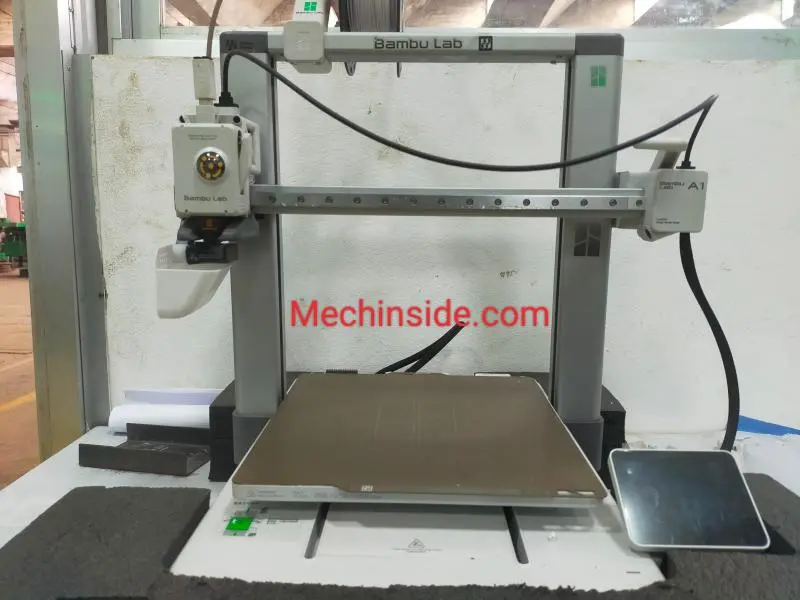
Today we are going to learn 3D printing in a very simple and clear way.
3D printing is a modern manufacturing technology where a machine creates real physical objects from a digital design made on a computer. The special thing about this technology is that it does not cut or remove material like traditional methods. Instead, it builds the object step by step, layer by layer.
To understand it simply, imagine you design something on a computer and a machine slowly turns that design into a real object you can touch. That is how 3D printing works.
Before this technology existed, manufacturing was very different. Traditional systems used molds, cutting, and shaping methods. This process was slow, expensive, and produced a lot of material waste.
Now let’s understand the process step by step.
First comes 3D design creation. A digital model is made using CAD software. This design must be very accurate because even small mistakes can affect the final output.
Then comes file format saving, usually STL, OBJ, or 3MF. Among them, 3MF is more advanced because it can store material and printing information along with shape data.
After that, the file is imported into slicing software. This is a very important step. Slicing software converts the 3D model into many thin layers and generates G-code instructions for the printer.
Before slicing, important settings must be checked:
Material selection is very important. PLA is easy to print, while ABS is stronger but needs higher temperature.
Then comes nozzle temperature setting. This controls how the material melts. For PLA it is usually 180°C to 220°C.
Another important setting is bed temperature, which helps the first layer stick properly. For PLA it is usually 50°C to 60°C.
Also important are layer height and print speed. Smaller layer height gives better quality but takes more time.
After slicing, the file is sent to the printer. Before printing starts, the machine must be prepared properly.
Bed leveling is very important because if the surface is uneven, the print can fail.
Then the printing process starts.
The printer heats the nozzle and bed. Then it begins printing from the bottom layer.
The first layer is the most important layer in 3D printing because if it fails, the entire print fails.
After that, the printer continues building layer by layer until the object is completed.
After printing, finishing work may be needed such as support removal, cleaning, or polishing.
3D printing has completely changed modern manufacturing systems by making production faster, cheaper, and more flexible.
It is used in industries like automotive, aerospace, medical, and education.
💬 Comments (0)
💬 Want to comment? Please login first.
🔐 Login to CommentNo comments yet. Be the first to comment!