
Safety Helmet Mold Manufacturing Process
Introduction
Safety helmets are one of the most important protective equipment used in industries, construction sites, factories, and engineering sectors. To manufacture strong and accurate safety helmets, industries use specially designed industrial molds.
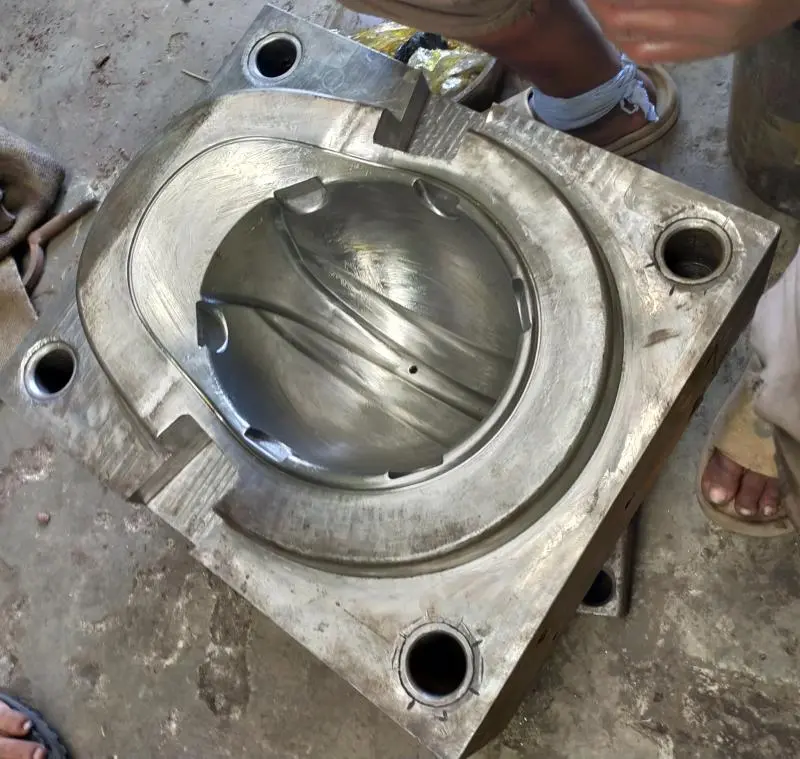
The mold shown in the picture is a safety helmet mold used in helmet manufacturing industries. This heavy steel mold is designed with precision engineering technology to produce helmet shapes with proper size and strength.
Modern industries use advanced CNC machining and mold manufacturing systems to create high-quality helmet molds for mass production.
What is a Safety Helmet Mold?
A safety helmet mold is a specially designed industrial tool used to produce plastic safety helmets. The mold contains a cavity shaped like the final helmet design.
Molten plastic material is injected into the mold under pressure. After cooling, the material takes the exact shape of the cavity and becomes a finished helmet shell.
The mold shown in the image appears to be a large industrial helmet mold with smooth cavity finishing and strong steel construction.
Importance of Helmet Mold Technology
Helmet quality depends heavily on mold accuracy. A properly designed mold ensures that every helmet has the correct thickness, shape, and structural strength.
Important benefits include:
Accurate helmet shape
Better product strength
Smooth surface finishing
Fast mass production
Consistent product quality
Reduced manufacturing defects
Without a quality mold, helmet safety performance may decrease.
Helmet Mold Manufacturing Process
The manufacturing process involves several engineering steps.
Design Preparation
Helmet shape is designed using CAD software.
Material Selection
Strong steel material is selected for mold manufacturing.
CNC Machining
The helmet cavity is machined using CNC milling machines.
Surface Finishing
Grinding and polishing are performed for smooth finishing.
Heat Treatment
The mold is heat treated to improve durability.
Final Inspection
Dimensions and cavity accuracy are checked carefully.
Features Visible in the Mold
Several engineering features can be seen in the image:
Large circular helmet cavity
Smooth polished surface
Heavy-duty steel body
Precision machining marks
Industrial mounting holes
These features indicate that the mold is designed for industrial production.
Materials Used in Helmet Mold Manufacturing
Helmet molds are usually manufactured from strong industrial steels.
Common materials include:
Tool steel
Alloy steel
Hardened steel
H13 steel
These materials provide high strength and long service life.
How Safety Helmets are Manufactured
After mold preparation, molten plastic material is injected into the cavity using injection molding machines.
The process includes:
Plastic melting
Injection process
Cooling stage
Mold opening
Helmet removal
Finishing and inspection
This system allows industries to produce helmets quickly and efficiently.
Industrial Applications of Safety Helmets
Safety helmets are widely used in:
Construction industries
Factories
Engineering workshops
Mining industries
Industrial production plants
Electrical maintenance work
These helmets help protect workers from head injuries and industrial accidents.
Advantages of Modern Helmet Molds
Modern helmet molds provide many industrial advantages.
High production speed
Accurate helmet dimensions
Better finishing quality
Lower defect rate
Long mold lifespan
Improved production efficiency
Because of these benefits, advanced mold technology is widely used in modern industries.
Conclusion
Safety helmet molds are an important part of modern industrial manufacturing systems. The mold shown in the image represents the role of precision engineering and mold technology in safety equipment production.
As industries continue to grow, the demand for high-quality helmet molds and advanced manufacturing systems will continue to increase.
💬 Comments (0)
💬 Want to comment? Please login first.
🔐 Login to CommentNo comments yet. Be the first to comment!