
Introduction
Forging technology is one of the most important manufacturing processes used in modern industries. Many heavy-duty metal components are produced through forging because forged products are usually stronger and more durable than normal cast products. Behind this entire process, the forging die plays a major role.
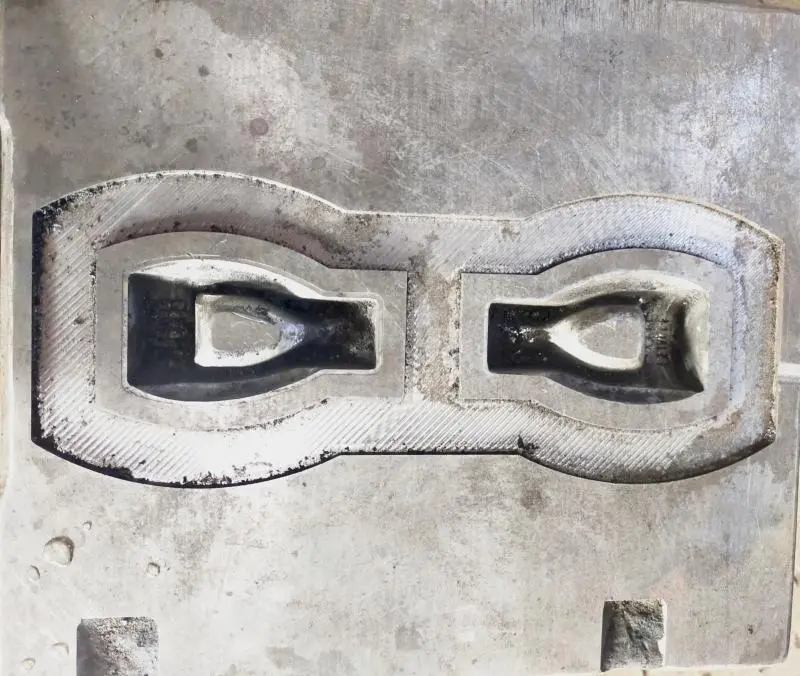
The metal block shown in the picture is a forging die. It is a specially designed industrial tool used to shape hot metal into a required form. Although it may look simple from the outside, it is actually made with high precision machining and engineering calculations.
Modern industries such as automotive, machinery, construction, and industrial equipment manufacturing heavily depend on forging dies for mass production.
What is a Forging Die?
A forging die is a hardened steel tool that contains a specially designed cavity. Heated metal is placed inside this cavity and high pressure is applied using a hammer or hydraulic press. As a result, the metal takes the exact shape of the die cavity.
In simple words, a forging die works like a mold for metal shaping.
The die shown in the image has two cavities, which means it can produce two identical parts at the same time. This increases production speed and efficiency.
How Forging Works
The forging process is completed in several important steps.
Metal Heating
First, the metal material is heated at a very high temperature until it becomes soft enough for shaping.
Die Setup
The forging die is installed properly inside the forging machine.
Metal Placement
The heated metal is placed between the upper and lower die.
Pressure Application
A forging hammer or hydraulic press applies heavy pressure.
Shape Formation
The metal flows into the cavity shape and forms the required product.
Finishing Process
Finally, excess material is removed and the product is finished properly.
Features of the Forging Die in the Picture
The forging die shown in the image appears to be used for producing industrial metal components. Several machining marks and cavity details are visible on the surface.
[color=magenta]Important features include:[/color]
- Hardened steel construction
- Precision cavity machining
- Dual cavity design
- Heavy-duty industrial structure
- Smooth internal finishing
These types of dies are usually manufactured using CNC machining, grinding, and heat treatment technology.
Importance of Forging Dies
Forging dies are extremely important in manufacturing industries because product quality mainly depends on die accuracy.
[color=magenta]A high-quality die offers many advantages:[/color]
- Accurate product dimensions
- Better surface finish
- Faster production
- Reduced material waste
- Longer tool life
- High production efficiency
Without a proper die, forged products may become defective or inconsistent.
Materials Used for Forging Dies
Forging dies must withstand high temperature and pressure. Because of this, ordinary steel cannot be used.
[color=magenta]Common materials include:[/color]
- Tool steel
- H13 steel
- Alloy steel
- Hardened industrial steel
These materials become very strong after heat treatment.
Industrial Applications
Forging dies are used in many industries around the world.
Automotive Industry
- Gear components
- Connecting rods
- Shafts
- Engine parts
Mechanical Industry
- Machine components
- Industrial fittings
- Heavy tools
Construction Industry
- Steel hardware
- Structural connectors
Agricultural Equipment
- Tractor components
- Farming tools
Open Die and Closed Die Forging
There are mainly two types of forging systems.
Open Die Forging
In this process, the metal is not completely enclosed inside the die.
Closed Die Forging
The die shown in the image is an example of closed die forging where the cavity creates an exact product shape.
Closed die forging provides:
- High accuracy
- Better repeatability
- Smooth finishing
- Fast mass production
Challenges in Forging Die Manufacturing
Manufacturing a forging die is not an easy task.
Several challenges include:
- High precision machining
- Heat treatment requirements
- Expensive tooling process
- Hard material cutting
- Design accuracy maintenance
Even a small mistake can damage the die or affect product quality.
Modern Technology in Forging
Modern forging industries now use advanced technology for die manufacturing.
Popular technologies include:
- CNC milling
- EDM machining
- CAD design
- CAM programming
- 3D modeling
These technologies improve production accuracy and reduce manufacturing errors.
Advantages of Forged Products
Forged products are stronger than many cast products because the internal grain structure of the metal improves during forging.
Advantages include:
- Higher strength
- Better durability
- Improved crack resistance
- Longer service life
Because of these benefits, forging is widely used in aerospace and automotive industries.
Maintenance of Forging Dies
Regular maintenance is very important for forging dies.
Continuous heat and pressure can damage the die surface over time.
Proper maintenance includes:
- Surface polishing
- Lubrication
- Crack inspection
- Dimensional checking
Good maintenance increases die life and maintains production quality.
Conclusion
Forging dies are one of the most important tools in modern manufacturing industries. Although they may look like simple steel blocks, they contain advanced engineering design and precision machining technology.
The forging die shown in the image represents the importance of industrial tooling in mechanical engineering and manufacturing sectors. As industries continue to grow, forging technology and die manufacturing will become even more important in the future.
💬 Comments (0)
💬 Want to comment? Please login first.
🔐 Login to CommentNo comments yet. Be the first to comment!