
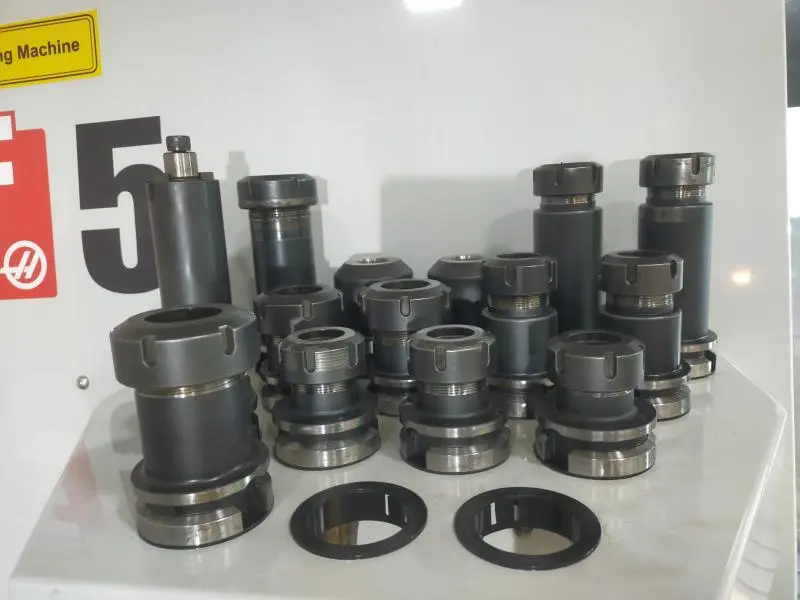
Modern industrial production systems have been revolutionized by CNC (Computer Numerical Control) technology. For manufacturing complex designs with high precision and speed, CNC machines are now widely used across almost every type of manufacturing industry. However, no matter how advanced a CNC machine is, its performance largely depends on the tooling system. Among these tooling components, the most important part is the CNC Milling Tools Holder.
In the image above, different types of CNC tool holders, collet chucks, and milling cutters are visible, which are mainly used for metal cutting, drilling, and finishing operations.
What is a CNC Milling Tools Holder?
A CNC Milling Tools Holder is a component that securely connects the cutting tool to the spindle of a CNC machine and holds it in the correct position. It ensures that the tool remains stable during machining and does not move or vibrate during operation.
Simply put, a tool holder is the connecting element that holds the cutting tool firmly and ensures the entire machining process is accurate and stable.
Importance of CNC Milling Tools Holder
Accuracy
The tool holder firmly grips the cutting tool, preventing vibration during machining. This ensures that every operation is completed with high precision.
Vibration Control
Excess vibration during machining can damage the work quality. A good tool holder reduces vibration and ensures smooth cutting performance.
Increased Production Efficiency
A stable tool holder allows the machine to run at higher speeds without interruption. This increases production rate and saves valuable time.
Longer Tool Life
Proper tool holding reduces unnecessary stress on the cutting tool, which helps extend its lifespan.
Main Types of CNC Milling Tools Holders
BT Tool Holder
One of the most commonly used tool holders. It is mainly used for heavy cutting and high-speed milling operations.
Collet Chuck Holder
Used for holding drills and end mills securely with high precision and stability.
End Mill Holder
Used for profile cutting, slot cutting, and side milling operations.
Face Milling Cutter Holder
Used for flattening and smoothing large metal surfaces.
Drill Chuck Holder
A simple but essential tool holder used for accurate drilling operations.
Role in Production Speed and Efficiency
A high-quality tool holder significantly improves machining efficiency. In industries where hundreds or thousands of parts are produced daily, time efficiency is extremely important.
A stable tool holder keeps the cutting tool firmly in place, allowing operations at higher speeds. This enables the production of a larger number of components within the same time frame. Additionally, it reduces machine downtime caused by frequent adjustments, ensuring continuous production flow.
Improving Surface Finish
In machining, cutting alone is not enough; the surface quality of the final product is equally important. If the tool vibrates during operation, it can create marks or rough surfaces on the product.
A good quality tool holder ensures stable cutting, which results in a much smoother and better surface finish.
Guidelines for Selecting a Tool Holder
Choosing the right tool holder is very important for machining performance.
- Must match machine spindle type
- Consider operating speed (RPM)
- Select according to tool type
- Ensure sufficient clamping strength
- Maintain high accuracy standards
Maintenance and Care
Proper maintenance is necessary to ensure long service life of tool holders.
- Clean after every use
- Remove dust and metal chips
- Apply anti-rust oil
- Store properly in racks
- Inspect regularly
Industrial Applications
CNC Milling Tools Holders are widely used in various industries, such as:
- Automotive Industry
- Aerospace Industry
- Mold and Die Manufacturing
- Heavy Engineering
- Medical Equipment Manufacturing
💬 Comments (0)
💬 Want to comment? Please login first.
🔐 Login to CommentNo comments yet. Be the first to comment!